
A two-part reflection following a Pint of Science 2026 talk
If the Industrial Revolution was about learning how to make things, the next phase was about learning how to control materials. By the early 20th century, metallurgy had become a scientific discipline, one that could explain and improve how materials behave. The focus shifted from shaping materials to designing them for increasingly demanding conditions. As power systems evolved, those demands became more extreme. One of the clearest examples of this is found in modern power systems.
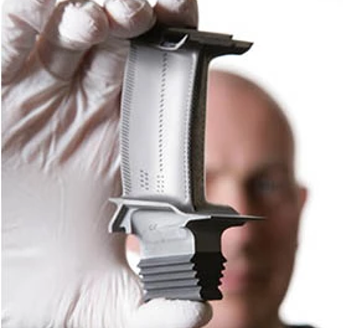
Today we have jet engines and gas turbines operating under extreme conditions. Introduced by people like Frank Whittle, from Coventry, and manufactured by companies like Rolls‑Royce, they rely fundamentally on materials. Efficiency is not about design only, it depends on materials and their microstructure. At the heart of the hottest sections of the most powerful and efficient jet engines are turbine blades shaped like aerofoils. Each blade generates enormous power, comparable to an engine inside a Formula 1 car, to drive the engine’s compressors. To operate, they must resist creep, fatigue, and oxidation under extreme temperatures and stresses. And that is what makes modern long‑haul air travel possible. Similar requirements apply in space applications, where materials must perform reliably under even the most hostile environments.
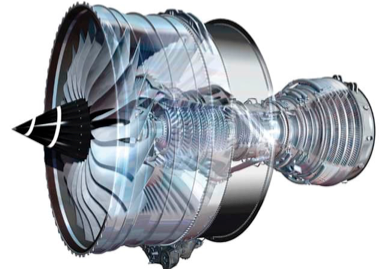
Meeting these demands requires a different approach. Part of my own journey into this field started with studying the effect of processing these turbine blades at high temperatures. The work that began during my PhD, and what brought me to Birmingham. Designing these components requires precise control over both materials and processing.
Turbine blades are single crystals made from nickel‑based superalloys containing multiple alloying elements. By removing grain boundaries, which act as weak points, one of the main failure mechanisms is eliminated. This allows engines to operate at higher temperatures, improving efficiency and lifetime. Their structure is carefully engineered through high-temperature processing, often close to their high melting point. Understanding and predicting their behaviour requires knowledge at the atomic level, how elements interact and how phases evolve at high temperatures. This is where computational thermodynamics becomes essential. Frameworks such as CALPHAD (CALculation of PHAse Diagrams) allow us to model these interactions and design materials more efficiently, reducing reliance on trial-and-error approaches.
This approach extend beyond this work, offering scalable pathways to other applications, including clean energy systems, nuclear materials, energy storage, and recycling. This work also sits within a wider environment at the University of Birmingham, where strong links between metallurgy and materials science, chemistry, and physics support new approaches to challenges in energy, climate, and natural resources.
The scale changes, but the underlying challenge is surprisingly similar. Instead of pushing materials to generate power, the challenge becomes detecting extremely rare interactions. In experiments searching for dark matter, the goal shifts from generating power to detecting these rare events. Dark matter does not interact with light, which makes it invisible to conventional observation. Yet it is estimated to make up about 85% of the matter in the universe. Detecting it requires extremely sensitive instruments.
What large collaborations aim to detect are collisions between dark matter particles and ordinary matter. When a particle interacts with the gas inside a detector, only the recoiling nucleus can be observed, creating a measurable signal. These interactions are incredibly rare. Here, materials play a different role. Dark matter candidates can be expected in a wide range of possible masses. As a result, different detectors are designed to target different possible mass ranges.

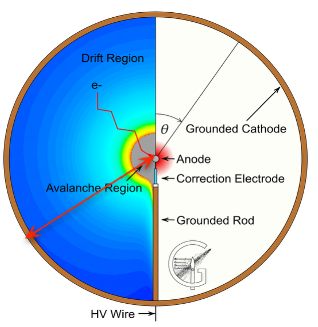
One approach uses spherical detectors, where a copper shell acts as a cathode and a central anode creates an electric field. In the case of a collision between a dark matter particle and a nucleus of the gas inside the detector, the recoil will liberate electrons. These electrons are attracted to the anode at the centre of the detector, where they create the measurable signal.
The main challenge is purity. Any contamination in the material can produce background signals, masking the events we are trying to detect. For this reason, detectors are built using ultra‑pure materials and are usually located deep underground to shield them from external radiation. Copper is commonly used because of its high conductivity and low intrinsic radioactivity. This is a different role from its use during the Industrial Revolution. Then, copper was often combined with zinc to form brass, enabling precision work and craftsmanship. Today, it becomes the main structural material in detection systems for dark matter and other rare-event searches, where purity and performance define what can be measured.
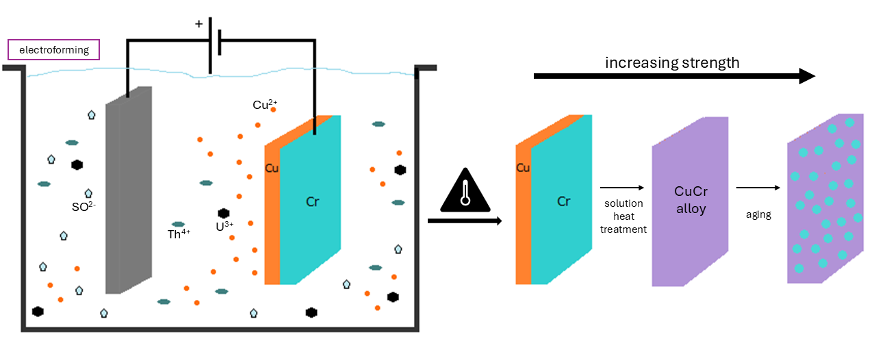
High-purity copper components can be fabricated using electroplating, building the material layer-by-layer under controlled conditions. First patented in Birmingham in the 19th century, it is also a method I first worked with during my Master’s thesis in Edinburgh, where I began to explore how materials can be built and controlled at a much finer level. At the University of Birmingham, researchers have established underground electroplating facilities. For example at Boulby, 1100m below the surface, to produce such ultra‑low background materials.
This is where my current work connects directly to the challenges for future discoveries in particle physics. I started to develop radiopure copper-based alloys using computational thermodynamics in Birmingham, following the award of the PureAlloys project. The goal is to make them stronger than pure copper while maintaining high purity. This means that detectors can be built larger or accommodate higher gas pressures, which increases their chances of detecting rare particle events.
We combine electroplating and thermal processing to control both composition and structure. During electroplating, conditions are selected so that only copper ions are deposited, minimising contamination. Subsequent heat treatments allow us to homogenise the material and tailor its microstructure for improved performance. This approach allows us to design materials that are both strong and radiopure, extending the capabilities of detector systems. Computational thermodynamics plays a role here as well, helping us design alloys and processing routes more efficiently, reducing trial-and-error and supporting more sustainable use of resources.
If we take a step back, a pattern becomes clear. From brass workshops and steam engines, to global industry, aerospace, space technologies, and experiments searching for dark matter, the same underlying challenge keeps appearing:
Materials enable systems.
Systems demand better materials.
And metallurgy evolves with them from industrial production to future discoveries.
Metallurgy in Birmingham connects the Industrial Revolution not just to modern engineering, but also to some of the most fundamental questions about our universe.
This is Part 2 of a two-part series.
Read Part 1: Metallurgy in Birmingham: the Industrial Revolution and its aura here.